PORTFOLIO
As a scientist I work towards a deeper understanding of the natural world. As an artist, I strive to communicate that understanding in beautiful and thought provoking ways.

Not so Straight[forward]: Queer Theory, Lichen Reproduction, and Art as Scientific Method
In his 1871 book, The Descent of Man and Selection in Relation to Sex, Charles Darwin expanded on his theory of evolution and outlined how competition for mates shapes physical and behavioral traits. Perhaps unwittingly, he also bequeathed this new theory of evolution with social norms about sex that still haunt the biological sciences to this day.
Darwinian evolutionary theory, with its emphasis on discrete individuals and competition as the primary driver of evolution, has historically marginalized cooperative, symbiotic, and multispecies modes of life. As Stacy Alaimo explains in Queer Ecologies: Sex, Nature, Politics, Desire, queer theory offers a powerful analytic framework for addressing these limitations.
Not-so Straight[forward] unifies scientific research, artistic practice, and queer theory under the lens of reproduction and diversity in lichens—symbiotic organisms found on every continent in the world. Using queer theory as an analytic framework and art and design as research methods, the project will investigate how multispecies partnerships within lichens impact their sexual reproduction, and how these dynamics challenge heteronormative assumptions embedded in the study of reproductive biology and evolutionary theory.
Field work for this project beings in September 2026.
Stay tuned for updates.


Podetia Printmaking
Prints with & inspired by lichens
Gel Plate
Crafted with live specimens.


Digital Designs
Riso-ready digital art


Risograph
Printed at Rad Riso and the Ann Arbor District Library


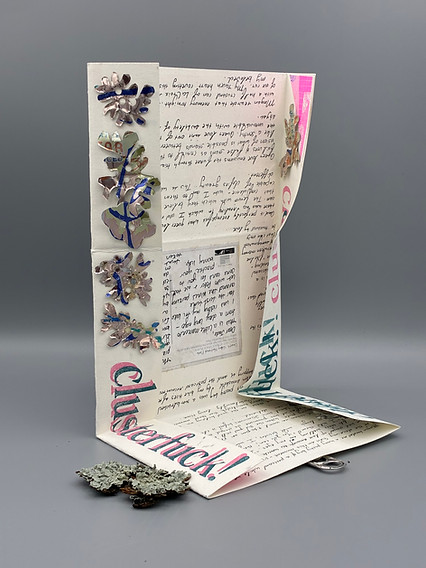
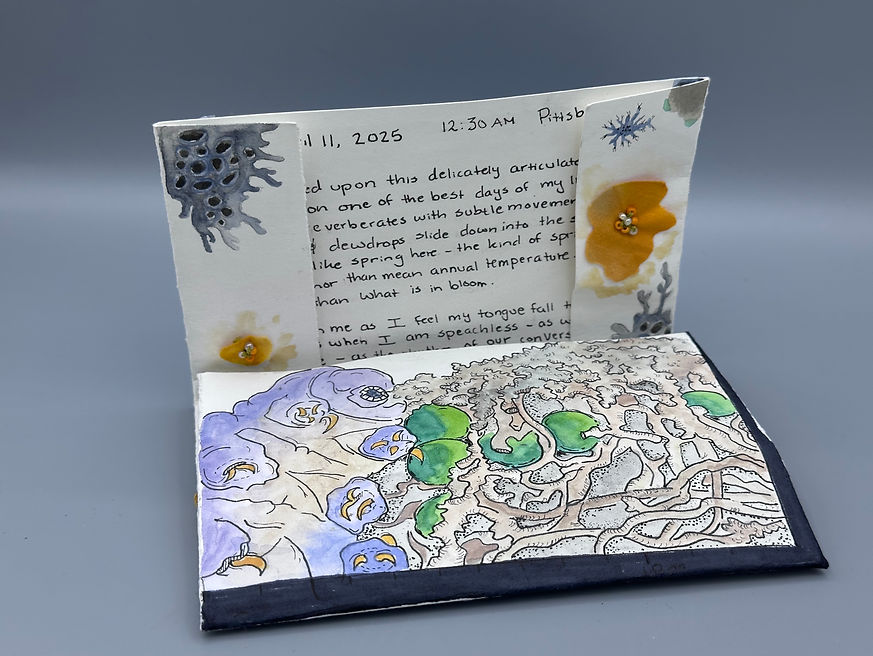
Clusterfuck: A Queer Herbarium
Clusterfuck is an autobiographical herbarium collection. These packets are part of a much larger collection-in-the-making, documenting my lifelong journey unlearning heteronormativity and mononormativity, Herbarium collections, like diaries, allow us to create a memory outside of ourselves and return to a specific place or moment in time. They provide an opportunity to revisit that moment with new eyes and new questions. In traditional herbariums, these questions are about evolution and ecology. In the case of Clusterfuck, the questions are about identity, relationships, self-discovery, and most importantly, love.